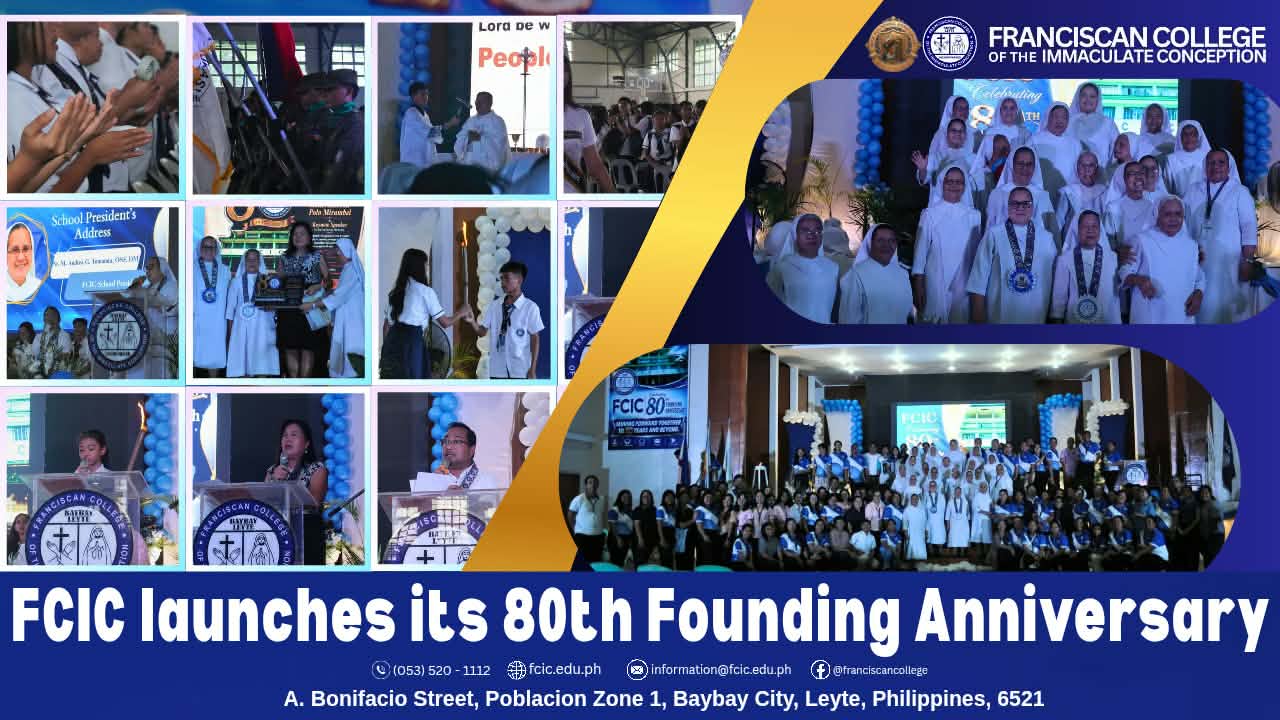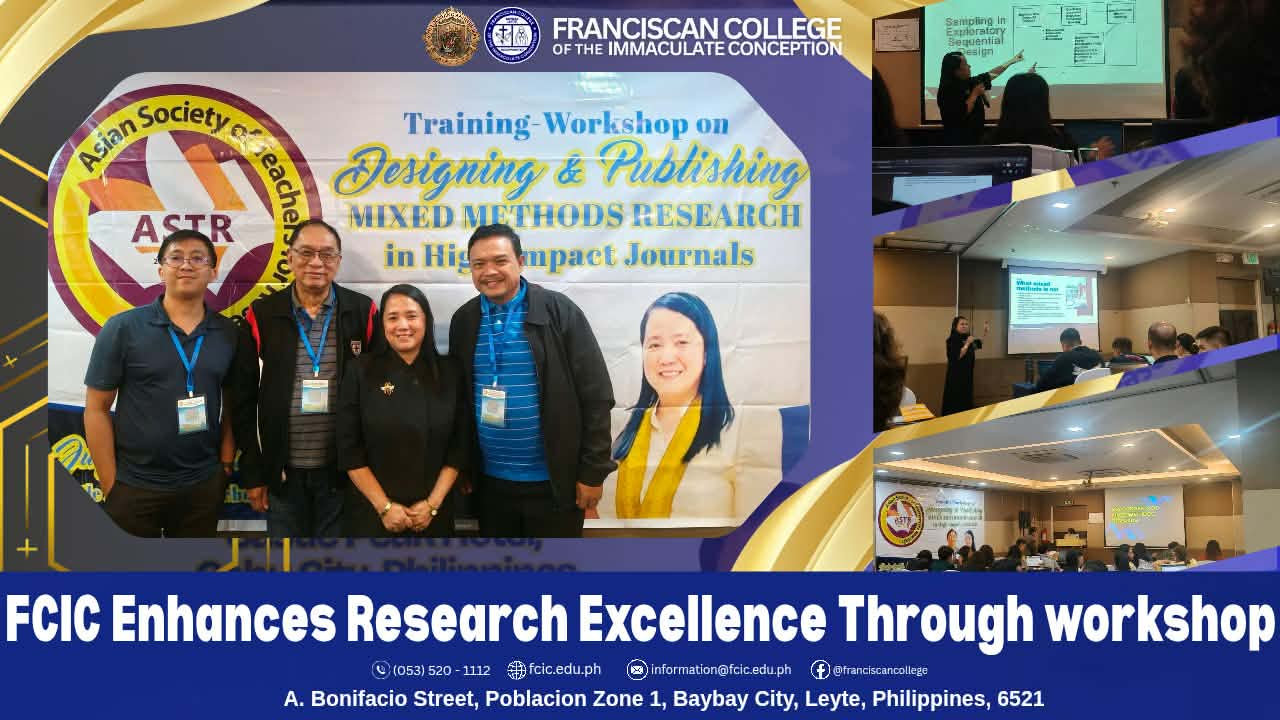
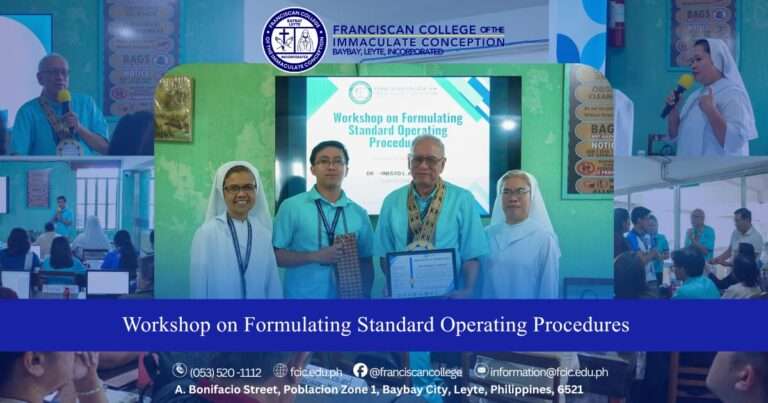
The Franciscan College of the Immaculate Conception successfully conducted the Workshop on Formulating Standard Operating Procedures (SOPs), spearheaded by the Office of the Quality Assurance. The activity gathered department heads and unit representatives in a unified effort to strengthen institutional systems and formally establish a more structured Quality Management System for the institution at the Discussion Room 2 – High School Library on February 23, 2026. The program opened with a prayer, setting a reflective tone for the day’s undertaking.
In her Opening Remarks, the School President, Sister Mary Michael G. Bactong, OSF, PhD, anchored her message on the Gospel of Matthew 25:31-46, highlighting the image of the Final Judgment. She emphasized that entry into the Kingdom of God was not based on vague intentions but on concrete, measurable acts of mercy, “I was hungry and you gave me food… I was a stranger and you welcomed me.” She underscored that even in salvation history, there is clarity of expectation, a clear standard, and a basis for evaluation.
Connecting the Gospel to the purpose of the workshop, she stressed that if the Kingdom of God operates on clear standards of lived action, then institutional excellence must likewise be intentional and structured. She articulated that this workshop was not merely about drafting documents but about establishing the FCIC Quality Management System — moving from informal practices to documented procedures, from personal styles to institutional standards, and from memory-based operations to system-based operations.
She highlighted three essential principles that frame institutional growth:
- Clarity – ensuring that roles, responsibilities, processes, and documentation are clearly defined so that expectations are understood even in the absence of supervision.
- Consistency – sustaining standards so that quality does not depend on personalities or circumstances, but remains stable and reliable across offices and services.
- Accountability – owning processes, documenting actions, monitoring results, and correcting deviations to ensure sustainability and integrity.
She reminded everyone that excellence is never accidental; it is intentional and system-driven. Institutional excellence, she noted, cannot depend on good intentions alone but must be supported by documented, standardized, and monitored procedures.
In a profound synthesis of faith and administration, she reassured participants that although there may be many procedures, their spirit can be summarized simply: just as Christ summarized the law as love of God and love of neighbor, the work of institutionalization can be grounded in glorifying God and respecting oneself and others. Thus, systems are not merely administrative tools but expressions of stewardship and service.
Following her address, Mr. Jie R. Lim, MACDDS, the Quality Assurance Officer, presented the workshop objectives, outlining the direction of the activity and emphasizing the production of draft SOPs that would form part of the institution’s operational backbone.
The Resource Speaker, Dr. Ernesto Alolor, Research Director, delivered an insightful and structured discussion on the formulation of effective Standard Operating Procedures. He explained the essential components of SOPs, including purpose, scope, responsibilities, step-by-step procedures, documentation, and review mechanisms. He emphasized that well-crafted SOPs promote accountability, transparency, efficiency, and alignment with institutional goals.
An engaging Question and Answer session followed, where participants clarified concerns and explored practical applications relevant to their respective units.
During the workshop proper, participants collaborated in drafting and refining their departmental SOPs. The session demonstrated strong teamwork, thoughtful analysis of existing processes, and a collective commitment to institutional improvement.
The presentation of outputs showcased structured drafts aligned with the principles discussed earlier. Constructive feedback further refined the documents, strengthening their clarity and applicability.
The Commitment Setting was facilitated by Mr. Jie R. Lim, who guided participants in affirming their dedication to finalize, implement, and regularly review their SOPs. He emphasized that manuals placed on shelves do not create change; transformation begins when offices take ownership of implementation.
The Dean of the College, Dr. Ma. Victoria Gonzaga, delivered a comprehensive synthesis, reiterating that systems ensure sustainability beyond individual leadership terms and transitions.
The Vice President for Academic Affairs, Sister M. Anette Escasinas, offered the Closing Remarks, encouraging everyone to translate the workshop outputs into consistent action and faithful practice.
The workshop concluded with a renewed commitment to clarity, consistency, and accountability. More than a technical exercise, the activity marked a major institutional step toward sustainability, integrity, and excellence.
Through this initiative, the Franciscan College of the Immaculate Conception reaffirmed that strong systems, grounded in faith and guided by shared responsibility, are essential in fulfilling its mission as a Christ-centered academic institution providing quality transformative Franciscan education.
By JIE R. LIM, MACDDS