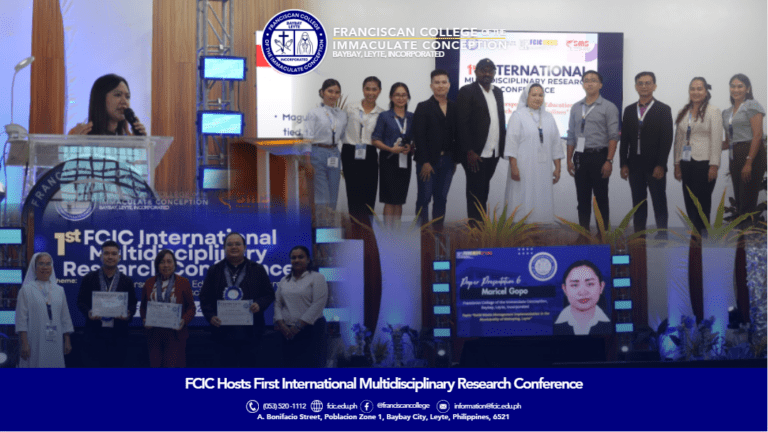
Baybay City, Leyte — “Research becomes truly meaningful when knowledge crosses borders, disciplines, and cultures.” With these words, Sister Mary Michael G. Bactong, OSF, Ph.D. Ed., School President, officially opened the inaugural International Multidisciplinary Research Conference (IMRC) at the Franciscan College of the Immaculate Conception (FCIC) on February 6–7, 2026. Themed “Global Perspectives in Educational Research across Disciplines,” this first-of-its-kind event brought together scholars, students, and educators from local and international institutions to share ideas, showcase research, and build connections.
Despite challenges posed by Tropical Storm Basyang, the conference went ahead with energy and optimism. Sister Mary Michael inspired attendees, comparing the experience to the disciples in the boat, reminding everyone that even in storms, faith and perseverance guide progress.
Leadership Recognized Worldwide
Keynote speakers praised Sister Mary Michael’s visionary leadership. Mr. Kalitazan Gannesa, Founder of Syscore Sdn. Bhd. Malaysia; Ms. Indra Shanti Thevar A/P Perumal Rajan from the University of Cyberjaya, Malaysia; and Dr. Sri of SMS Phoenix Malaysia highlighted her courage in creating an international platform for knowledge sharing, noting that she “builds the bridge while crossing it.”
Strong Institutional Support
The Commission on Higher Education (CHED) provided key support. While Regional Director Dr. Maximo C. Aljibe, PhD, DPM, CESO III could not attend due to a national meeting, his message was delivered by Dr. Maria Mylah M. Javier, CHED Education Supervisor II and OIC Chief Administrative Officer. In his message, Dr. Aljibe commended FCIC’s leadership and initiative in hosting its first international multidisciplinary conference, praising the College for connecting institutions and disciplines across borders and encouraging participants to pursue excellence in research and innovation. Sister Mary Michael expressed heartfelt thanks for the recognition, noting that this support strengthens FCIC’s commitment to global academic engagement and inspires both faculty and students to aim higher.
Comprehensive Program and Active Student Participation
The conference drew 411 participants, including 64 research presenters, 219 general attendees, 71 observers, and 57 committee members. The two-day program featured:
- RoboCamp sessions, where students actively took part in robotics challenges, teamwork exercises, and hands-on problem-solving, showing creativity, cooperation, and curiosity.
- Parallel research presentations for Higher Education and Senior High School, covering topics from industry skills, vocational education, and language instruction to student financial literacy, reading habits, and sustainable agriculture. Notable presentations included:
- “Optimization of Production Parameters of Coconut Shell Charcoal and Dry Banana Leaves for Enhanced Solid Block Fuel Efficiency” by Dr. Isagani B. Jacob
- “Teachers’ Perception on the Effectiveness of Code-Switching in English Medium Instruction Classes” by Aileen Clarissa Capiral
- “The Reading Habits and Critical Thinking Skills of the Grade 11 Students of FCIC” by Antonette Jewel O. Damot
Interactive workshops, panel discussions, and networking sessions allowed participants to connect across disciplines and institutions, encouraging meaningful exchanges and collaboration. Observers noted how students’ energy and curiosity brought life to every session, complementing the academic focus of the research presentations.
Sister Mary Michael also recognized Dr. Ernesto Alolor, Dr. Maria Victoria Gonzaga, and Sir Jie Lim for their leadership in organizing the conference. She further praised the entire organizing committee and support staff for their hard work in managing every part of the event, from planning and scheduling, coordinating with international and local speakers, handling registrations, and ensuring the smooth flow of RoboCamp and research sessions, to managing technical support, materials, and logistics. Their careful preparation, teamwork, and dedication ensured each session ran smoothly, participants were well supported, and the conference experience was engaging and meaningful for everyone. This combined effort turned the vision of the first IMRC into reality and set a strong foundation for future conferences.
By uniting scholars, educators, and students from near and far, the IMRC highlighted FCIC’s growing influence in the world of research. The energy, creativity, and expertise displayed over the two days show what can be achieved when knowledge, innovation, and curiosity intersect. This milestone conference marks the start of many more opportunities for learning, collaboration, and meaningful impact.
By Sister Maria Isabel Arnaiz, OSF