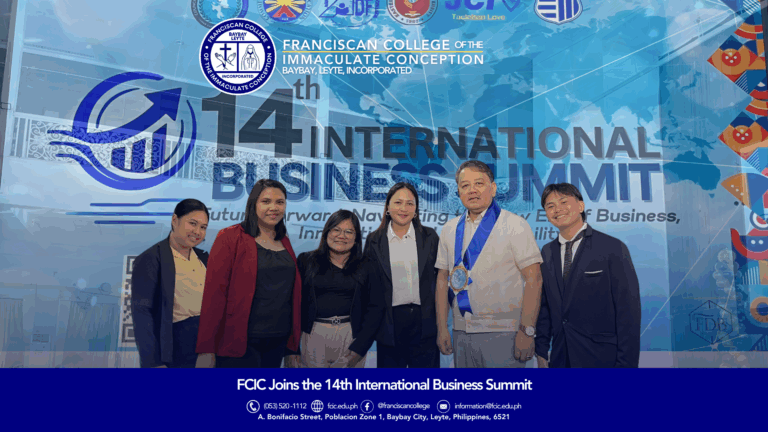
The Franciscan College of the Immaculate Conception – Bachelor of Science in Business Administration Department, represented by Mrs. Glenn E. Visto, MPA, Dean of College of Business Management and Administration, Ms. Fatima Irene L. de la Peña LPT, Program Head of Business and Office Administration, Mrs. Sigrid Niña S. Belmonte, LPT, Moderator of Modern Business Achievers Club, Miss Reshyl Loreto, MBA Club President and Mr. Ronel M. Dapar, a BSBA-HRM student, proudly joined the 14th International Business Summit held at People Center’s and Library, Tacloban City on November 20-21, 2025.
The summit convened leaders, educators, government officials, and industry experts to explore the theme “Future Forward: Navigating the New Era of Business, Innovation and Sustainability”. The day opened with a Welcome Remarks by Dr. Analyn C. Españo, EVSU Vice President for Internationalization and External Affairs. She emphasized the summit’s 14-year history of collaboration and inspiration, highlighting the importance of sustainable and transformative action. Dr. Españo, reminded the participants that “behind wearing corporate attire lies of a story of hope, dreams and inspiration”. Dr. Felix Dexter O. Barrion, Summit Director, acknowledged the different participating schools, noting that their active engagement strengthens the spirit of collaboration that the summit aims to foster. Dr. Edward Y. Chua, President of the Council of Deans and Educators in Business – Eastern Visayas, Inc., encouraged participants to embrace unity, sustainability, and forward-thinking leadership. A message from Dr. Dennis C. de Paz, EVSU University President, was delivered by Dr. Danilo B. Pulma, Vice President for Research, Innovation & Extension Services. His message reinforced the academe’s commitment to innovation and research-driven development.
Following the messages, the Keynote Speaker was introduced by Dr. Benedicto T. Militante, J.D., EVSU Vice President for Academic Affairs. The Keynote Speaker, Dr. Maximo C. Aljibe, CESO lll, Commission on Higher Education Region Vlll Director, underscored the vital role of Higher Education Institutions in shaping the future education and industry. First, he highlighted HEIs as drivers of innovations-design solutions, experimenting with emerging technologies such as Artificial Intelligence (AI), incubating ideas and challenging long-standing assumption. Second, he emphasized their role as catalysts of business transformation through promoting product designs with minimal environmental impact, reducing carbon footprints and equipping learners with literacy in climate science and climate finance. Third, he described HEIs as bridges between technology and people, noting that this requires authenticity, empathy and commitment to lifelong learning. Fourth, he identified HEIs as platforms for inclusive growth, focusing on social enterprises development and strengthening global connections through student mobility programs.
Dr. Aljibe stressed that HEIs must transform memorization into action, theory into application and simulations into innovations. He also outlined CHED’s key initiatives toward building a future-ready Higher Education Institutions. These include: strengthening internationalization and global competitiveness through expanded collaboration with ASEAN or EUROPEAN institutions; accelerating digital transformation by providing upskilling and training in Artificial intelligence; embedding innovation and entrepreneurship across academic programs; supporting SMEs and local government units through community extension activities and promoting quality assurance in business education through enhanced curriculum standards.
He concluded with a powerful call to action; for students to cultivate future-ready mindset anchored in innovation, and for deans and educators to be an architect of economic progress – continuing research, innovation, and industry collaboration while remaining globally competitive and purpose-driven.
After Dr. Aljibe’s message, a video greeting from Senator Bong Go was shown, followed by reading of Vice President Sara Z. Duterte’s message, both extending their support and congratulating the organizers for successfully holding the summit.
In the afternoon, Hon. Carlos Jericho “Icot” Petilla represented by Hon. Marie Kathryn Veloso – Cabigting, Board Member in the Province of Leyte, delivered Topic 1 “Sustainable Development and Economic Transformation: A Provincial Government Perspective”. She emphasized the 17 Sustainable Development Goal (SDG) 2030, highlighting key targets such as zero hunger, ending poverty and providing quality education. She also mentioned a newly crafted ordinance (October 2025), the Leyte Integrated Health System, which aims to consolidate and streamline health-related data across the province.
Topic 2 “Future-Ready Tourism Integrating Infrastructure, Innovations and Sustainability” was delivered by Dr. Mark T. Lapid, Chief Operating Officer of Tourism Infrastructure and Enterprise Zone Authority (TIEZA), a department under the Department of Tourism. TIEZA’s mission is “to contribute to national tourism development goals and showcase Philippine culture by designating, supervising, and regulating sustainable Tourism Enterprise Zones; undertaking viable Tourism Infrastructure Projects; and managing assets”. Dr. Lapid, shared TIEZA’s investments and their impact in boosting Philippine Tourism. He also presented sustainable tourism practices using the triple bottom line approach, integrating economic, social and environmental considerations.
The topic “Empowering MSMEs for Sustainable and Inclusive Economic Growth” was delivered by Dr. Faustino “Jojo” V. Gayas, Provincial Director of Department of Trade and Industry – Leyte. He highlighted programs the empower Micro Small and Medium Enterprises (MSMEs), such as One Town One Product (OTOP), Next Gen, Youth Entrepreneurship Programs and Shared Service Facilities.
Mr. Steadman Brice Strickland, JD, Director – B2B Sales Services, US Key Account Manager of Concentrix, discussed the “The Future of Work: Balancing Technology with Humanity”. He discussed the evolving nature of work in the Artificial Intelligence (AI) era, emphasizing lifelong learning, ethics and human-centered leadership.
Mrs. Tanya Samillano, a consultant of Insular Oil Corporation addressed energy innovation in her topic, “Fueling the Future: Innovation, Sustainability, and Leadership in a Changing Energy Landscape”. She focused on biofuels and locally sourced alternatives, highlighting sustainable solutions to meet the evolving energy demands of the country,
The final topic of the day, “Wage Equation in Business, Innovation and Sustainability” was presented by Atty. Miguel Tezon, Regional Tripartite Wage and Productivity Board. He discussed wage structures and policies designed to promote fairness, encourage innovation and uphold social responsibility in the workplace
The first day of the summit highlighted the vital role of the education, innovation, sustainable development, tourism, MSME empowerment, and energy solutions, reminding us that through collaboration, research, and socially responsible action, we can create a future-ready, inclusive and transformative society.
The second day of the summit was opened by Dr. Edward Y. Chua, followed by the acknowledgement of participants by Dr. Felix Dexter O. Barrion, FBE, Summit Director.
Topic 7, “Future Forward: Leading, Learning and Innovating in the Age of Acceleration” was presented by Philip Tnee, Head of North and South Asia (APAC sans ANZ and JP), Senior Director, KnowBe4. He shared insights on leadership, learning, innovation in a rapidly evolving technology landscape emphasizing that change is immediate and pervasive. Sir Philip stressed the importance of cultivating empowered people, a strong organizational culture, and ethical innovation. Using real-world examples from Meta, TikTok, and other global companies, he highlighted technology, creativity, and empathy can be integrated to building high-performing teams and authentic brand connections.
“The Future of Work: Skills, Culture, and Leadership in the Age of AI and Automation” topic was discussed by Dr. Maria Victoria U. Rosas, President, Philippine School of Business Administration and President of Philippine Council of Deans and Education in Business. She outlined the evolving workplace in the Era 5.0, referencing the ongoing industrial revolution and its transformative impact on business society. Dr. Rosas emphasized digital transformation, interdisciplinary skills and collaboration while stressing the importance of complex problem-solving, emotional intelligence, and lifelong learning. She also encouraged government, business and academia to work together to ensure inclusive and sustainable development.
Director Mylene C. Rosales, Regional Director of DEPDev Regional Office VIII was represented by Mr. Matthew B. Añosa, Economic Development Specialist II, Policy Formulation and Planning Division of DEPDev. He discussed regional development strategies aimed at driving inclusive economic growth in Eastern Visayas, focusing on agriculture, tourism, infrastructure, and social protection. He emphasized the importance of strategic planning and coordinated action in creating resilient and sustainable communities. Key projects highlighted included the Samar-Pacific Coastal Road, Leyte Ecological Industrial Zone, and Tacloban Airport Development.
The topic on “Good Governance and Local Innovation: Building Business-Ready and Sustainable Communities” was presented by Mrs. Rudith A. Roca, Region 8, Chief of Local Government Capability Development Division (LGCDD), in behalf of the Regional Director of Department of the Interior and Local Government Mr. Arnel M. Agabe, CESO III. She highlighted that the Local Government Code of 1991 empowered LGUs to become self-reliant communities and active partners in nation-building. Entrepreneurial LGUs adopt proactive, innovative leadership to stimulate economic growth, attract investments, generate employment, and improve constituents’ quality of life. The Department of the Interior and Local Government (DILG) support LGUs by promoting local autonomy, strengthening capacity, monitoring compliance, and ensuring effective service delivery. Key governance pillars include institutional development, performance oversight, citizen empowerment, administrative efficiency. Through the initiatives like the Seal of Good Local Governance (SGLG), LGUs can implement priority projects in education, health, housing, local economic development, ecological solid waste management, transparency, and disaster resilience. Strategic approaches such as streamlined business processes, digitalization, and investment initiatives enhance competitiveness and ease of doing business. The vision is to build peaceful, safe, progressive resilient and inclusive communities – aligned with the national development goals of a prosperous and resilient Philippines under AmBisyon Nation 2040.
The participation of the Franciscan College of the Immaculate Conception – BSBA Department in the 14th International Business Summit demonstrates FCIC’s commitment to its mission of fostering academically innovative and socially responsive global citizens. By engaging with esteemed speakers, industry leaders, and peer institutions, the event provided our students and faculty with a wealth of insights into emerging trends in business, technology, sustainable development and leadership.
The 14th International Business Summit provided a valuable platform for learning, collaboration, and inspiration, allowing FCIC to showcase its commitment to academic excellence, innovation, and social responsibility. Through the insights shared by distinguished speakers and the exchange of ideas with other institutions, participants gained practical knowledge, future-ready skills, and a deeper understanding of sustainable and inclusive business practices.
This experience reinforces FCIC’s mission to develop competent, ethical, and globally minded business leaders while strengthening its role in community development and industry engagement. Moving Forward Together, FCIC is committed to translating these learnings into actionable programs, innovative initiatives, and collaborative partnership that continue to empower students, faculty and the broader community.
by Glenn Visto