Introduction
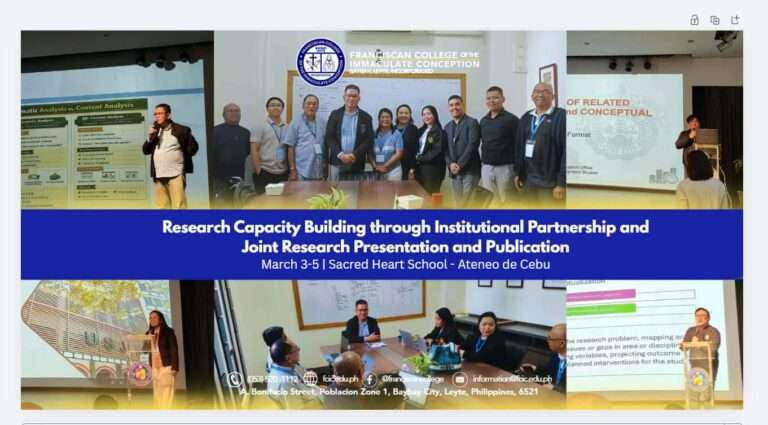
The Research Capacity Building through Institutional Partnerships and Joint Research Presentation and Publication conference, organized by the Catholic Educational Association of the Philippines (CEAP), was held from March 3–5, 2026, at Sacred Heart School – Ateneo de Cebu. Designed as a platform for collaboration, the event brought together educators, researchers, and academic leaders from various institutions to strengthen research capacity, foster partnerships, and encourage joint scholarly outputs.
With sessions ranging from orientation and plenary discussions to mentor–mentee workshops and research presentations, the conference emphasized the importance of shared expertise and collective effort in advancing academic research. Guided by the principle that “research not shared is research not done, and research not used is research undone,” the gathering highlighted the value of dissemination, collaboration, and institutional synergy.
For the Franciscan College of the Immaculate Conception (FCIC), participation in this event was both a commitment and an opportunity—to reinforce its vision of research excellence, to engage in meaningful partnerships, and to contribute to the broader academic community through collaborative inquiry and publication.
Day 1: Strengthening Institutional Commitment to Research
The Franciscan College of the Immaculate Conception (FCIC) actively participated in the three-day conference. The event convened educators, researchers, and institutional partners to foster collaboration in research and promote joint presentations and publications. Representing FCIC were Mr. Jie R. Lim, MACDDS, Quality Assurance Officer, and Dr. Ernesto L. Alolor, Research Director. Their presence underscored FCIC’s unwavering commitment to advancing research development and cultivating stronger academic linkages.
Through this engagement, FCIC reaffirmed its mission of nurturing a culture of research excellence, one that extends beyond its own academic community and contributes to the broader educational landscape.
Day 2: Mentor–Mentee Research Collaboration
The second day of the conference highlighted the importance of mentor–mentee collaboration in shaping research directions. The session emphasized consultation, feedback, and alignment of research topics with institutional priorities and academic standards.
Dr. Dennis V. Madrigal, Dean of the Recoletos de Bacolod Graduate School, University of Negros Occidental – Recoletos, served as mentor, guiding participating schools in refining their proposed research endeavors.
Mentee-institutions included Franciscan College of the Immaculate Conception, Baybay, Leyte, Incorporated, Christ the King College of Calbayog City, Inc., St. Michael Academy of Catarman, Samar, and Colegio San Nicolas de Tolentino – Recoletos
This collaborative exercise provided FCIC and its partner schools with a valuable platform to strengthen research directions, ensuring that outputs are both academically rigorous and institutionally relevant.
Day 3: Presentation of Research Outputs
The final day of the conference continued the mentor–mentee collaboration, culminating in the presentation of research outputs. Each participating institution showcased the progress of their refined research topics, demonstrating the impact of mentorship and collaborative consultation.
The presentations highlighted innovative approaches, institutional relevance, and academic rigor, reflecting the collective effort of schools to elevate research standards. For FCIC, the output presentation reinforced its dedication to producing meaningful research that contributes to both institutional growth and the wider academic community.
The day’s activities not only validated the mentor–mentee process but also provided opportunities for constructive critique, peer learning, and recognition of collaborative achievements. By sharing outputs, institutions strengthened their commitment to joint research endeavors and laid the groundwork for future publications and partnerships.
Conclusion
FCIC’s active involvement across all three days of the conference reflects its dedication to building research capacity through partnerships and shared initiatives. From institutional representation, mentor–mentee collaboration, to the presentation of outputs, FCIC demonstrated its vision of research excellence and its role in fostering a culture of collaboration.
Through this engagement, FCIC continues to advance its mission of contributing meaningfully to the academic community at regional and national levels, ensuring that research remains a cornerstone of institutional development and educational innovation.